Updated July 2026 · Research-led review compiled from KEF documentation, published measurements and owner reports; links checked July 2026. We have not bench-tested this pair ourselves.
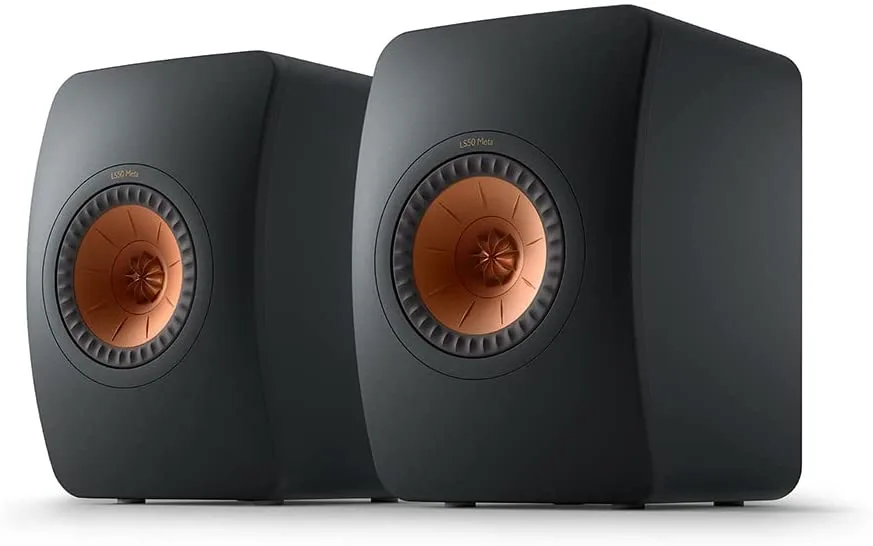
The LS50 Meta is what happens when a marketing gimmick turns out to be real. KEF’s Metamaterial Absorption Technology — a plastic disc behind the driver whose maze-like channels absorb about 99% of the sound radiating backward — measurably cleans up what reaches your ears from the front. Reviewers who measure (not just listen) confirmed it: this is one of the best-engineered small speakers ever sold. It is also small, bass-limited and power-hungry, and pretending otherwise is how buyers end up disappointed. Both halves of that story below.
Short answer: for imaging, midrange precision and that disappearing-speakers trick in a small-to-medium room, the LS50 Meta is the class benchmark — ElectroTalks rating: 4.5/5. Budget for a genuinely capable amplifier and, if you love bass, a subwoofer: at 85 dB sensitivity with bass rolling off below the ~80 Hz region, both matter more than the brochure admits.
KEF LS50 Meta specs
| Type | 2-way bookshelf, 12th-gen Uni-Q coaxial driver |
| The trick | Metamaterial Absorption Technology (absorbs ~99% of rear driver radiation) |
| Sensitivity | 85 dB — low; wants real amplifier current |
| Bass reach | Useful output into the ~80 Hz region; deep bass needs a sub |
| Amp pairing | Quality 60–100+ W solid state recommended; entry receivers sell it short |
| Placement | Stands, away from walls — the imaging depends on it |
What it does better than anything near its price
The coaxial Uni-Q layout — tweeter at the acoustic center of the midwoofer — makes the speaker behave like a single point source, and the result is the LS50 party trick: close your eyes and the speakers vanish, leaving voices and instruments hanging in space between them. The Meta disc then removes the subtle rear-wave hash that colored the original LS50, and the consensus across measurement-driven and subjective reviewers alike is rare unanimity: cleaner treble, more believable midrange, class-leading precision. For acoustic music, jazz, vocals and nearfield desks-with-ambition, there is not much argument at the price.
The three catches
- It is power-hungry. 85 dB sensitivity means an entry-level receiver runs out of clean volume early — exactly the clipping scenario that makes good speakers sound bad. Pair with an amp that has genuine current reserves.
- Physics wins on bass. A 5.25″ driver in a small sealed-ish box does not do the bottom octaves. For movies or bass-forward music, plan the sub from day one — KEF’s own KC62 is the matching choice, any good sub works.
- It exposes the chain. Speakers this resolving pass along harsh sources and bad placement without mercy. Stands, space from the wall, and decent electronics are part of the real price.
Verdict — ElectroTalks rating: 4.5/5
Buy it — if imaging and midrange truth in a small-to-medium room are the mission and the amplifier budget is real. It depends — home-theater-first buyers: pair with a sub from the start or choose towers. Skip it — if it would hang off an entry receiver in a big open room; cheaper, easier speakers will sound better in that system — our bookshelf brands guide maps that territory.
Completing the system: the KEF S2 stands (★ 4.7) put the Uni-Q at ear height as designed, and the KEF KC62 subwoofer is the brand’s matching answer to the bass catch.
KEF LS50 Meta FAQ
What amplifier do I need for the LS50 Meta?
Something with genuine current delivery – quality solid-state amplification in the 60-100+ watt class is the sensible floor. At 85 dB sensitivity, entry-level receivers run out of clean output early and make an excellent speaker sound strained.
Does the LS50 Meta need a subwoofer?
For music at moderate levels in smaller rooms, many owners live happily without one. For home theater or bass-forward genres, yes – useful output fades below the ~80 Hz region, and a sub (KEF’s KC62 is the matching unit) completes the range.
What does Metamaterial Absorption Technology actually do?
A labyrinth-structured disc behind the driver absorbs roughly 99% of the sound radiating backward into the cabinet, energy that otherwise reflects back through the cone as distortion. Independent measurements confirm cleaner treble and lower coloration versus the original LS50.
LS50 Meta vs LS50 Wireless II – which one?
Same acoustic platform, different philosophy: the Meta is passive (you supply amp and sources), the Wireless II builds amplification and streaming in. Choose the Meta if you enjoy the separates path or own good amplification; the Wireless II if you want the one-box-per-speaker system.