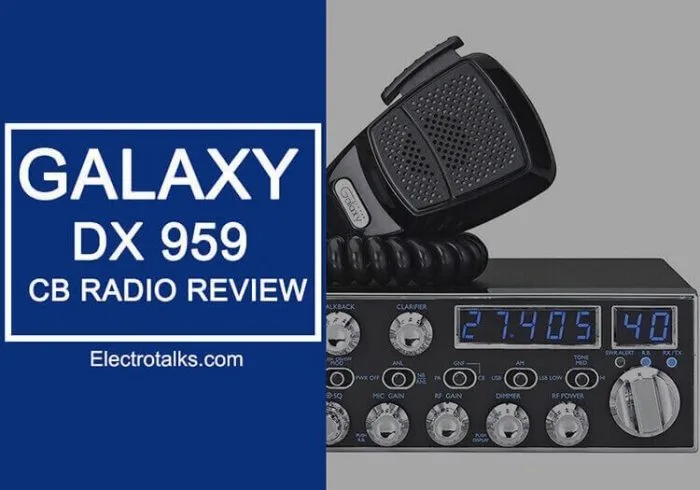
Updated July 2026 · Research-led review: specs verified against manufacturer documentation and long-term owner reports; links checked July 2026. We have not bench-tested this unit ourselves.
Every legal CB radio in America transmits the same 4 watts on AM. The $40 one, the $200 one — same power, by law. So why does the Galaxy DX 959 cost three times what a basic CB does? One word: sideband. On SSB the legal limit jumps to 12 watts PEP, the signal squeezes into a narrower slice of the channel, and your effective range roughly doubles — legally. The DX 959 is one of the cheapest ways to get well-built SSB in a mobile CB, and that is the entire case for buying it.
Short answer: if you will actually use SSB, the DX 959 is the workhorse to buy — big meter, clarifier that works, more operator controls than almost any certified CB. ElectroTalks rating: 4.5/5. If you only ever talk AM channel 19, skip it and save the difference: our Uniden PRO510XL review covers the $40 radio that does that job just as well.
The features that actually matter (and the one quirk)
The 959 carries more operator controls than almost any other FCC-certified CB — and unlike most spec-sheet padding, these are controls you touch:
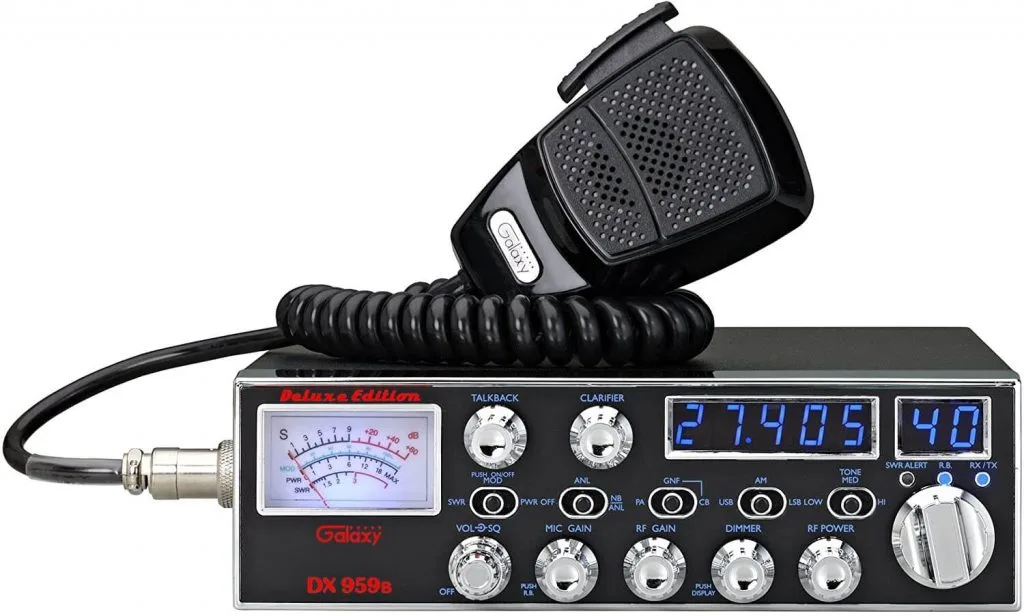
- The big 4-scale meter. Signal, power, modulation and SWR on one large, readable face. The SWR scale plus automatic SWR calibration means you can check your antenna match without wiring in a separate meter — the single most useful convenience on the radio.
- Clarifier (delta-tune) that is actually usable. Fine-tuning voices is the make-or-break of SSB, and the 959’s clarifier is smooth enough to do it while driving.
- Variable output power + RF gain + mic gain. Dial transmit down for close-range convoys, quiet a crowded receiver, and set your audio punch properly instead of shouting.
- 5-digit frequency counter — you see exactly where you are, which matters on SSB where “close” sounds like Donald Duck.
- High-SWR alert, talkback, roger beep, PA output — all switchable, mercifully.
- The known quirk: owners consistently report slight SSB frequency drift during the first minutes of warm-up, settling once the radio reaches operating temperature. Not a dealbreaker; worth knowing so you do not chase the clarifier for the first ten minutes.
Galaxy DX 959 specs
| Channels | 40 (FCC-certified CB) |
| Modes | AM / SSB (LSB & USB) |
| Transmit power | 4 W AM / 12 W PEP SSB (legal maximums) |
| Frequency counter | 5-digit |
| Meter | Large 4-scale: signal / power / modulation / SWR, auto SWR calibration |
| Operator controls | Variable power, RF gain, mic gain, clarifier, talkback, roger beep, PA |
| Chassis | Full-size — measure your dash before ordering |
| Current version | DX 959B (blue frequency display) |
Pros and cons
Pros
- SSB at a workhorse price — the legal range upgrade
- Best-in-class meter with auto SWR calibration
- Full set of real operator controls
- Galaxy’s famously loud, punchy transmit audio
- Long production run — parts, mods and knowledge everywhere
Cons
- Full-size chassis — genuinely hard to fit in modern dashes
- SSB drifts slightly until warmed up (owner-reported)
- Overkill if you will only ever use AM
- SSB range gain requires the other station to run SSB too
The range question, honestly
On AM, vehicle-to-vehicle with decent antennas, expect 2–5 miles — same as any legal CB, because the 4-watt limit is doing the deciding, not the radio. On SSB with tuned antennas at both ends, doubling that is realistic. Two caveats: both sides need SSB radios, and none of it works over a badly tuned antenna. The antenna and its SWR decide more of your range than the radio does — set it up with an SWR meter and a proper antenna like a Firestik before blaming the transmitter.
How it compares to the radios you are cross-shopping
| Radio | SSB | Freq. counter | The one-line difference |
|---|---|---|---|
| Galaxy DX 959 | Yes | Yes (5-digit) | The full package — this review |
| Galaxy DX 949 | Yes | No | Same core radio minus the counter — the budget SSB route |
| Uniden Bearcat 980SSB | Yes | Display | The modern-styled SSB rival with noise-cancelling mic |
| Cobra 29 LTD Classic | No | No | The AM-only icon — buy only if SSB truly does not matter |
Verdict — ElectroTalks rating: 4.5/5
Buy it — if SSB is in your plans. It is the feature you are paying for, and the 959 does it well at this price with the controls to use it properly. Skip it — if you are an AM-only user; a PRO510XL gets you the same legal 4 watts for a third of the money. It depends — if what you really want is more power: the legal route to serious wattage is a ham licence and a 10-meter radio, not a bigger CB — see our Stryker 10-meter guide.
Galaxy DX 959 FAQ
What is the difference between the DX 959 and DX 959B?
The 959B is the current production version of the same radio. The core specs are unchanged – 40 channels, AM/SSB, frequency counter – with the B adding the blue frequency display and cosmetic updates. Buying new today, you are buying the 959B.
Does the DX 959 drift on SSB?
Slightly, during warm-up – owners consistently report minor SSB frequency drift in the first minutes that settles once the radio reaches operating temperature. It is a known trait of the model, not a defect in your unit.
Do I need a licence to use the Galaxy DX 959?
No. CB radio in the US is licence-free by rule under FCC Part 95. The DX 959 is a certified CB operating at the legal limits – 4 watts AM and 12 watts PEP on SSB.
Is SSB worth it on a CB radio?
If the people you talk to also run SSB radios, yes – the 12-watt PEP limit and narrower bandwidth roughly double practical range. If your group is AM-only, SSB buys you nothing until they upgrade too.
What antenna should I pair with it?
A properly tuned full-size antenna matters more than the radio. A 102-inch whip is the reference; a quality fiberglass antenna like a Firestik is the practical choice for most vehicles. Tune it with an SWR meter – or use the 959’s built-in auto SWR calibration – before judging range.