Updated July 2026 · Links checked July 2026.
Two things to know before you buy. First, every tower here is passive — it needs a separate amplifier or AV receiver to make any sound (our receiver guide covers good matches). Second, most are sold individually — the Polk, Klipsch, Sony and Pioneer prices are per speaker, so order two for stereo. Only the Dayton T652-AIR ships as a pair.
Floor-standing towers are the speakers you buy when bookshelf models are not enough — bigger cabinets mean deeper bass, higher output and a fuller sound, with no stands to buy. “Best brand” is the wrong way to shop, though: every brand makes good and bad towers. The useful question is which brand’s flagship-for-the-money fits your room and budget.
Below are five brands worth your money, each represented by the tower that earned its reputation — all passive, all with hundreds or thousands of verified owner ratings.
Top picks at a glance
- Best all-rounder: the Polk Monitor XT60.
- Best for big rooms: the Klipsch R-820F.
- Cheapest real pair: the Dayton T652-AIR.
| Brand & model | Sold as | Owner rating | Best for |
|---|---|---|---|
| Polk Monitor XT60 | Single | ★ 4.5 (481) | All-round value |
| Klipsch R-820F | Single | ★ 4.7 (247) | Big rooms / home theater |
| Sony SSCS3 | Single | ★ 4.6 (1,320) | Detail / music |
| Pioneer SP-FS52 | Single | ★ 4.6 (1,092) | Budget legend |
| Dayton Audio T652-AIR | Pair | ★ 4.4 (442) | Cheapest pair |
1. Polk — Polk Monitor XT60
Best all-rounder. The Monitor XT60 is the tower most people should start with: Hi-Res certified, with a smooth Terylene tweeter, a 6.5-inch woofer and dual passive radiators for bass that belies its slim cabinet. It plays music cleanly and slots straight into an Atmos home theater. A balanced, do-everything tower. The catch: Sold individually, so buy two for stereo, and it wants a subwoofer for the deepest bass.
Verdict — Buy it: the safe, balanced choice for most living rooms.
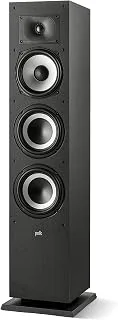
2. Klipsch — Klipsch R-820F
Best for big rooms. With dual 8-inch woofers and Klipsch’s horn-loaded Tractrix tweeter, the R-820F fills a large room effortlessly and hits hard with movies. Its high sensitivity means it goes loud on modest power, which is why it is a home-theater favourite for front left/right duty. The catch: The biggest, priciest tower here; the lively horn is not to every taste.
Verdict — Buy it: the pick for large rooms and movie nights.
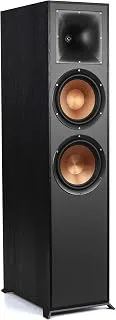
3. Sony — Sony SSCS3
Best for detail. The SSCS3 is a true 3-way, 4-driver design with a dedicated super-tweeter, so it pulls out airy detail that cheaper 2-way towers miss. For music-first listeners on a budget it is the standout, with over 1,300 ratings and a wide, even soundstage. The catch: Passive and a touch lean in the lowest bass; best with a sub for movies.
Verdict — Buy it: the pick for detailed, music-led listening on a budget.
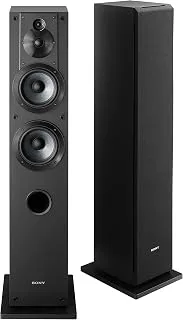
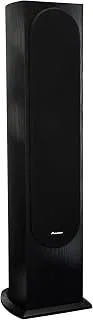
4. Pioneer — Pioneer SP-FS52
Best budget tower. Andrew Jones designed the SP-FS52 to embarrass speakers costing far more, and a decade on it still does. A six-element crossover and triple 5.25-inch drivers give it a coherent, grown-up sound at a giveaway price. It is the classic first real tower. The catch: Older design, modest sensitivity, and sold singly.
Verdict — Buy it: the budget tower that started a thousand hi-fi setups.
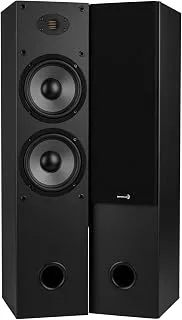
5. Dayton Audio — Dayton Audio T652-AIR
Best value (sold as a pair). The T652-AIR is the cheapest way to get a real pair of towers, and the AMT (folded-ribbon) tweeter gives it a smooth, airy top end that is rare at this price. Crucially it ships as a pair, so the headline price is for two speakers, not one. The catch: Light in the deep bass and basic cabinet, but unbeatable value.
Verdict — Buy it: the pick when you want a stereo pair for the least money.
How to choose a floor-standing speaker brand
Three questions decide it. How big is the room? A large living room rewards the dual-8-inch Klipsch; a normal room is well served by the Polk, Sony or Pioneer. What matters most — movies or music? Klipsch for movie impact and volume, Sony and Pioneer for music detail, Polk for a balance of both. What is the budget? The Dayton pair is the cheapest entry, the Pioneer the budget single, and the Klipsch the step up.
Remember that a tower is only half the system: pair it with a capable amp or AV receiver (our 8-ohm receiver guide helps) and add a subwoofer if you want the lowest bass. Tighter on space? Compare these with our bookshelf speaker brands, or for a clean-wall look see in-wall speaker brands. For a TV-first room, our best soundbar brands guide is the simpler route, and the home audio hub ties it all together.
Floor-standing speaker FAQ
Are floor-standing speakers sold in pairs or singly?
It varies. Most premium towers — including the Polk, Klipsch, Sony and Pioneer here — are sold individually, so you buy two for stereo. Budget models like the Dayton T652-AIR ship as a pair. Always check the listing before ordering.
Do floor-standing speakers need an amplifier?
Yes. Every tower on this list is passive, meaning it needs a separate stereo amplifier or AV receiver to produce sound. Match the amp to the speakers’ impedance (usually 6-8 ohms) and your room size.
Are floor-standing speakers better than bookshelf speakers?
For bass and output, generally yes — the larger cabinets move more air, so towers go deeper and louder without stands. Bookshelf speakers can match them for detail and suit smaller rooms and budgets. For a big living room, towers are usually the better fit.
Do I still need a subwoofer with tower speakers?
Not always, but it helps for movies and bass-heavy music. The dual-8-inch Klipsch has the most bass on its own; slimmer towers like the Sony and Dayton benefit most from adding a subwoofer.
How much amplifier power do tower speakers need?
Most of these are happy with a 50-150W per channel receiver. High-sensitivity designs like the Klipsch go loud on less, while the Pioneer and Dayton appreciate a bit more power to come alive.
n