Updated July 2026 · Research-led comparison based on rated specs, the FCC rules cited below, and aggregated long-term owner reports. Links checked July 2026.
Licence note: Baofeng and Yaesu handhelds discussed here are amateur (ham) radios. Listening is legal for anyone; transmitting on amateur bands requires an FCC amateur licence (Technician class or higher — a multiple-choice exam, no Morse code). These are not CB, FRS or GMRS radios.
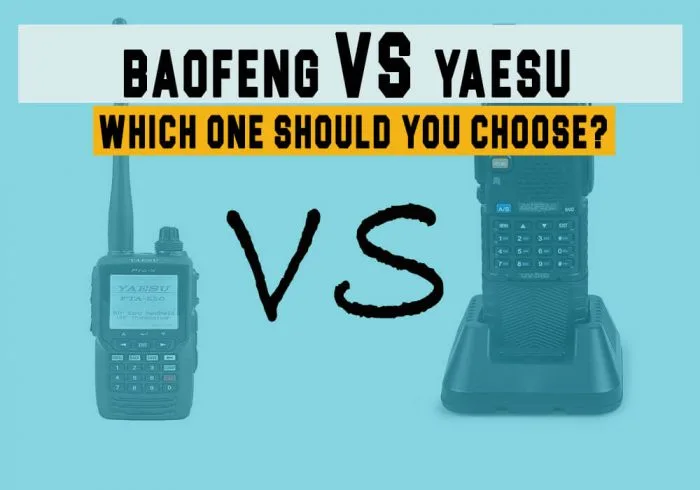
One of these radios costs $25. The other costs four to six times that. The spec sheets look nearly identical: dual band, 5-ish watts, same repeater capability. So is Yaesu charging you for the nameplate? No — but what Yaesu is actually selling is not on the spec sheet, and whether it is worth it depends entirely on which buyer you are.
Short answer: first radio, backup radio, glovebox radio — buy the Baofeng and stop agonizing; at $25 the value is absurd. The radio you will still be using in five years — buy the Yaesu FT-60R. Many hams sensibly own both.
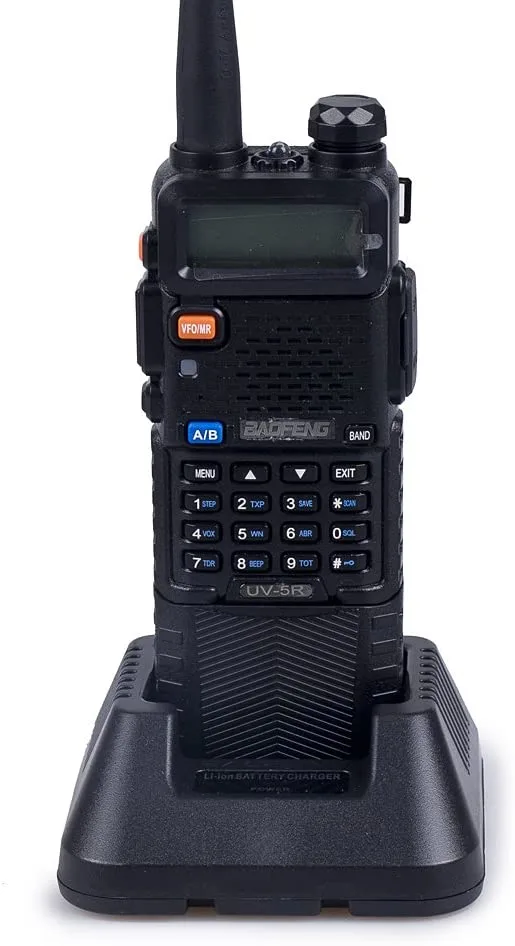
Baofeng vs Yaesu, side by side
| Baofeng (UV-5R class) | Yaesu (FT-60R class) | |
|---|---|---|
| Price | $ — cheapest working HT made | $$$$ — 4–6× the Baofeng |
| Bands | 2m / 70cm dual band | 2m / 70cm dual band |
| TX power | ~5 W (8 W claimed on high-power models) | 5 W |
| Receiver front-end | Overloads easily near strong RF — city centers turn to mush | Selective; stays usable in RF-dense areas — this is what you pay for |
| Emissions record | Spurious-emission compliance historically spotty on some models | Clean, consistent, certified |
| Programming | Menu maze — most owners surrender to CHIRP and a USB cable | Three knobs, sane menus, programmable from the keypad |
| Build | Light plastic; semi-disposable by design | The HT hams pocket-carry for a decade |
| Extras | Flashlight, FM broadcast radio | Neither — and nobody misses them |
| Warranty / support | Effectively “buy another one” | Real warranty, real company, real parts |
| Best for | First radio, go-bag, truck spare | Daily driver, RF-dense areas, keeps |
The case for Baofeng: $25 changes the question
The UV-5R family did something genuinely disruptive: it made a working dual-band ham handheld cost less than a tank of gas. For a new Technician licensee, that means getting on the air the week you pass the exam. It transmits, it receives, it does repeaters, and if you drop it in a river you are out one pizza.
What the $25 does not buy: quality control is a lottery ticket — most units are fine, some ship with deaf receivers or drifting frequency. The receiver front-end overloads easily near strong RF (city centers, repeater sites), turning busy bands into mush. Spurious-emission compliance has been a recurring FCC sore spot for cheap imports. And support is effectively “buy another one.”
The case for Yaesu: the receiver is the product
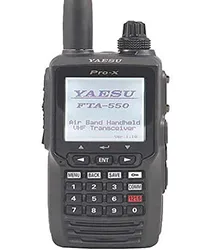
A Yaesu FT-60R costs five Baofengs, transmits the same 5 watts, and sounds identical on your friend’s radio across town. The difference is everything around the transmitter: a receiver that stays selective when the band is crowded, a chassis that survives a decade of pocket-carry, three-knob operation you can run without the manual, and a company that still answers the phone. Transmit power is capped by physics and the licence class; receive quality is where the money goes, and it is the half of the conversation the spec sheet skips.
The 2026 lineup check
The classic matchup was UV-5R vs FT-60R, and it still frames the decision honestly — but the shelves have moved. On the Baofeng side, the newer UV-5RM / AR-5RM class adds USB-C charging, bigger batteries and 8–10 W claims for a few dollars more; treat the wattage claims with the usual Baofeng salt (double the watts is not double the range — range lives in the antenna and the receiver). On the Yaesu side, the budget FT-4X and FT-65R undercut the FT-60R’s price while keeping the clean receiver; the FT-60R remains the durability pick and the one the used market still hunts for. The brand calculus does not change: Baofeng competes on price, Yaesu on everything after the purchase.
Wait — do you actually want GMRS?
A good chunk of “Baofeng vs Yaesu” searchers really want family or off-road comms — that is GMRS, not ham. Different service, different rules: GMRS needs a no-exam $35 family licence, and it requires GMRS-certified radios. The ham handhelds on this page are not certified for GMRS and are illegal to transmit there, even at matching power. If that is your use case, buy a GMRS-certified radio (Baofeng makes those too — the UV-9G class) and skip the ham exam entirely. For trail comms comparisons, see our motorcycle CB guide for the licence-free option.
Pros and cons
Baofeng
- Absurd value; painless entry to the hobby
- Cheap spares, batteries and accessories everywhere
- Flashlight + FM radio extras
- QC lottery; receiver overloads in cities
- Menu-maze programming (CHIRP required, realistically)
- No meaningful support or warranty
Yaesu
- Selective receiver that works where Baofengs drown
- Decade-grade build; three-knob usability
- Real warranty and support
- 4–6× the price for the same transmit watts
- No gimmick extras, if you wanted them
Verdict
Buy the Baofeng — if you are new, testing whether the hobby sticks, or building a go-bag. Get the licence, learn on it, lose nothing. Buy the Yaesu — if radio is becoming a real hobby, you live somewhere RF-dense, or you are tired of fighting the Baofeng’s receiver. Own both — the actual answer for half the hams reading this: Yaesu on the belt, Baofeng in the truck.
Going all-in on a base station instead? That conversation is our Yaesu FT-991 vs FT-991A comparison.
Baofeng vs Yaesu FAQ
Can I use a Baofeng or Yaesu handheld without a licence?
You can listen without any licence. Transmitting on amateur bands requires an FCC amateur licence – Technician class covers VHF/UHF where these handhelds operate. Transmitting unlicensed risks FCC enforcement, and these radios are not certified for CB, FRS or GMRS use.
Can I use these radios on GMRS?
No. GMRS requires GMRS-certified radios and its own no-exam licence. Ham handhelds like the UV-5R and FT-60R are not certified for GMRS and are illegal to transmit there. If family or off-road comms is the goal, buy a GMRS-certified radio – Baofeng UV-9G class – instead of a ham HT.
Why are Baofengs so cheap?
High-volume Chinese manufacturing, a shared chipset across dozens of models, minimal quality control, and no meaningful support or warranty infrastructure. The transmitter is honest value; the corners were cut in the receiver, QC and compliance testing.
Is Baofeng quality really that bad?
Most units work fine, which is why they are everywhere. The risks are unit-to-unit variance, receiver overload near strong signals, and historically spotty spurious-emission compliance on some models. At $25, owners treat them as semi-disposable.
Which Yaesu handheld should a beginner buy?
The FT-60R is the long-standing recommendation: rugged, simple, excellent receiver, and cheap enough that the Yaesu premium does not sting. The budget FT-4X and FT-65R are the cheaper 2026 alternatives; buy fancier models when you know what feature you are missing.